
How the reusable pen works
4 min read · Updated May 2026 · MY PEPTIDES Research Team
Key facts
The reusable pen is a precision volumetric dispensing device built around a 3 mL cartridge. Turning the dose knob rotates a threaded push-rod, which converts that rotation into linear travel and advances a plunger forward to displace solution from the cartridge; a tactile click ratchet produces one audible, feelable click per increment, making each click a discrete, repeatable step rather than a free-running slide. Mechanically, one click equals 1/300th of a full plunger advance. The cartridge holds 3.0 mL and one click dispenses a fixed 0.01 mL, giving 300 clicks per cartridge (3.0 mL ÷ 0.01 mL). That fixed step is what makes volumes repeatable across a study. Before measuring, a set of priming clicks expels air from the cartridge and needle path so later clicks dispense liquid rather than air. This device is for in-vitro laboratory research use only — it meters volume, not a dose, and is not for human or veterinary use.
The reusable pen is a precision volumetric dispensing device for a 3 mL cartridge. This guide explains how the mechanism meters consistent, repeatable volumes — purely as device documentation.
Research use only — a dispensing device, not dosing guidance. This explains the mechanics of measuring and dispensing volumes of reconstituted solutions for in-vitro laboratory research. It is not guidance on human or animal use, it does not cover administration technique, and it contains no dosing protocols. Researchers determine the volumes appropriate to their own experiments.
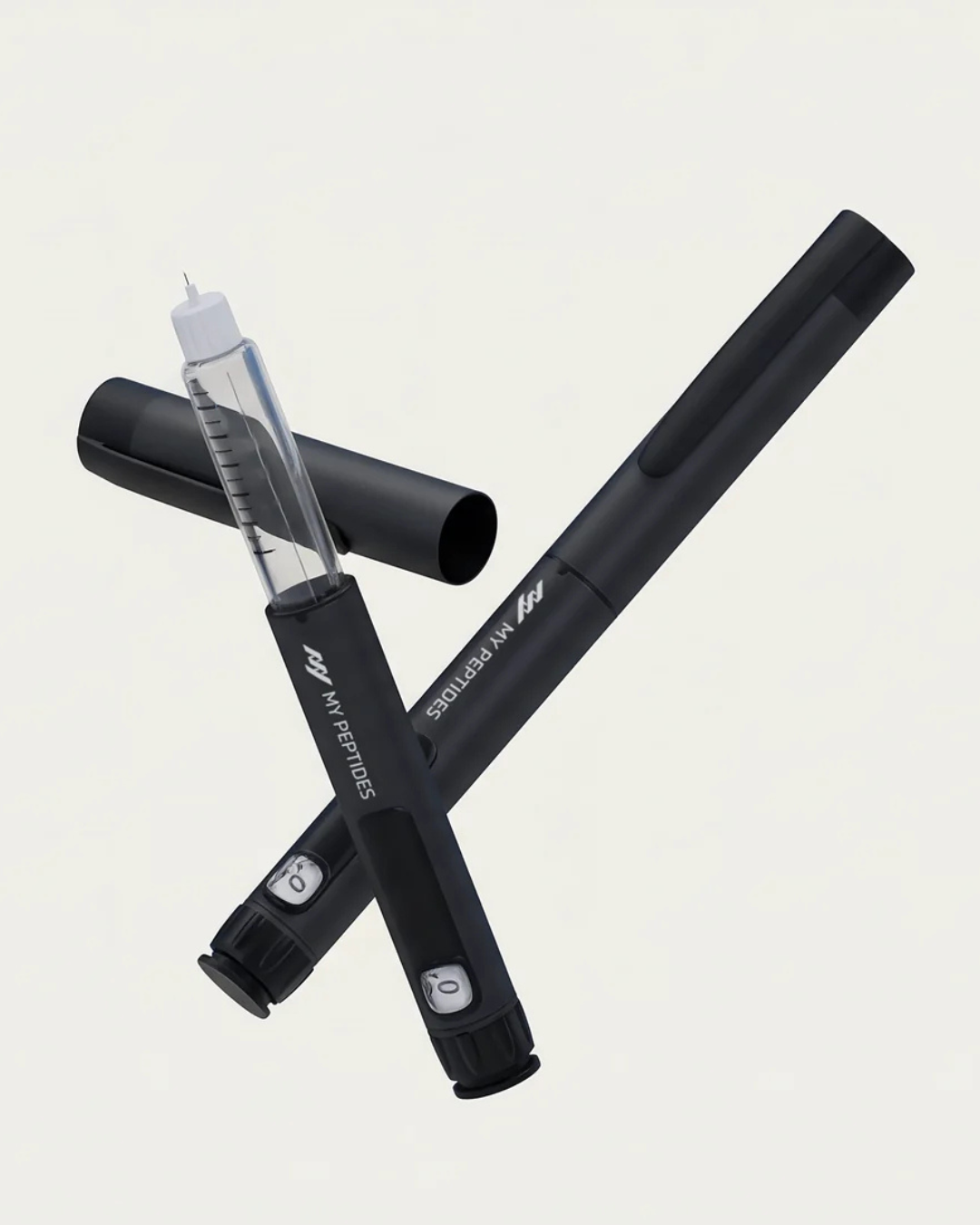
The components
- Dose knob — turned to set the increment.
- Tactile click ratchet — gives an audible/feelable "click" per increment.
- Threaded push-rod — converts rotation of the knob into linear travel.
- Plunger — driven forward by the push-rod to displace solution from the cartridge.
- 3 mL cartridge — holds the reconstituted research solution.
- Needle hub and needle — the dispensing tip.
How a "click" works
Turning the dose knob rotates the threaded push-rod, which advances the plunger forward by a fixed, precise amount. The ratchet produces one tactile click per increment, so each click is a discrete, repeatable step rather than a free-running slide. Mechanically, one click = 1/300th of a full plunger advance.
Volume per click
The arithmetic follows directly from the cartridge size and the increment:
- Full cartridge volume: 3.0 mL
- One click: 0.01 mL
- Total clicks per cartridge: 3.0 mL ÷ 0.01 mL = 300 clicks
That fixed 0.01 mL step is the whole point of the device — it lets you dispense the same small volume consistently, which is what makes measurements repeatable across a study.
Priming
Before measuring, a number of initial priming clicks are used to expel air from the cartridge and needle path so that subsequent clicks dispense liquid rather than air. This is a one-off mechanical preparation step, not part of measuring a volume.
Why precision matters in research
Repeatability is everything in a research workflow: a device that delivers the same 0.01 mL per click removes a source of variability, so results can be attributed to the compound rather than to inconsistent handling. Start from a verified material with a batch-specific Certificate of Analysis, store solutions correctly (storage guide), and choose an appropriate solvent (bacteriostatic water & stability).
See the Reusable Auto-Injector Pen or browse the full catalogue.
Peptide Pen — Reusable Auto-Injector
Available now from MY PEPTIDES — 99%+ purity, COA with every order, fast UK dispatch.
Frequently asked questions
- How many clicks are in a 3 mL pen cartridge?
- With a fixed increment of 0.01 mL per click, a 3 mL cartridge gives 300 clicks (3.0 mL ÷ 0.01 mL). This is device mechanics — it describes volume, not a dose.
- How much volume is one click?
- One click advances the plunger by a fixed 0.01 mL — 1/300th of a full 3 mL cartridge. The consistent increment is what makes volumetric dispensing repeatable.
- What is priming on the pen?
- A one-off set of initial clicks that expel air from the cartridge and needle path so later clicks dispense liquid rather than air. It is a mechanical preparation step, not part of measuring a volume.